February 9 – 10, 2016
After a 5 or 6-hour flight (who remembers anymore), we landed in Jordan –
Aqaba to be specific. We flew over Egypt and the Suez Canal. Really nice flight!
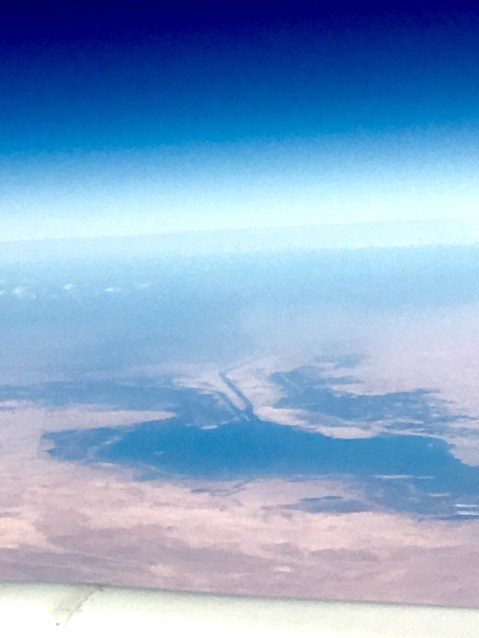
I think I could possibly be cured of fear of flying after all this time in the air! Probably not and one can hope I guess. We still had a nice long bus ride to our hotel in Wadi Mousa, directly across the entrance to Petra.
Jordanian people are so welcoming, and can they cook! The food is my favorite! Stewed tomatoes, humus, olives, fresh juices…delicious!
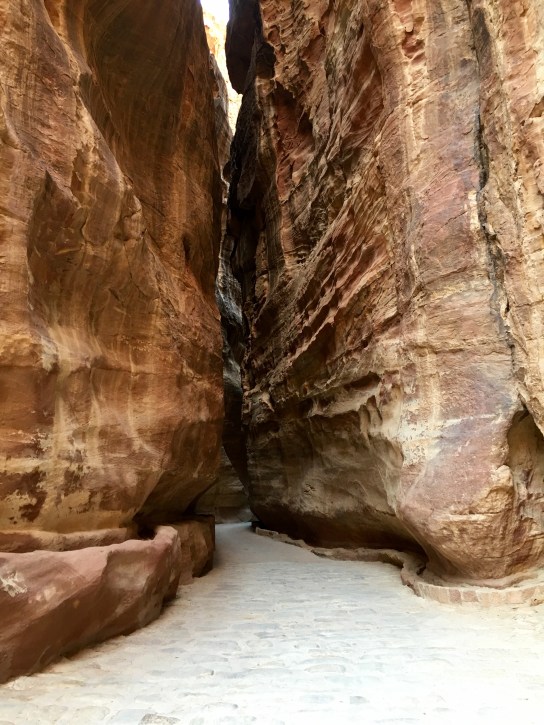
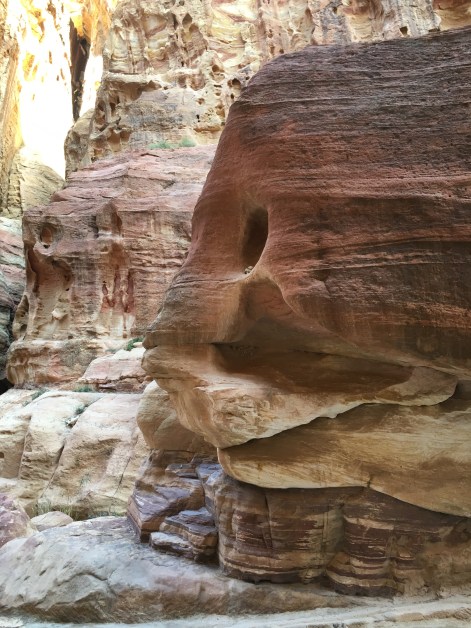
We elected to visit Petra early so that we could spend as much time as possible exploring. Petra has been inhabited since prehistoric times. The ancient city was rediscovered in 1812 by the Swiss explorer Johan Burckhardt. He convinced the locals that he was a Muslim seeking to make a pilgrimage to the Tomb of Harun. He was the first westerner to see Petra since its decline several centuries before. This Nabataean city, situated between the Red Sea and the Dead Sea, was an important crossroads between Arabia, Egypt and Syria-Phoenicia. Petra is half-built, half-carved into the rock, and is surrounded by mountains riddled with passages and gorges. It is one of the world’s most famous archaeological sites, where ancient Eastern traditions blend with Hellenistic architecture. Dating to around 300 B.C., it was the capital of the Nabataean Kingdom. These people were genius! They devised a water delivery and storage system that is still visible on either side in the Siq. The Siq is a narrow gorge that leads visitors into Petra and resulted from a natural splitting of the mountain. It is about ¾ of a mile long and very narrow is spots…quite beautiful. The entrance to Petra and seeing the Treasury is jaw dropping beautiful! And the trek down to the city is crazy great, and very dramatic.
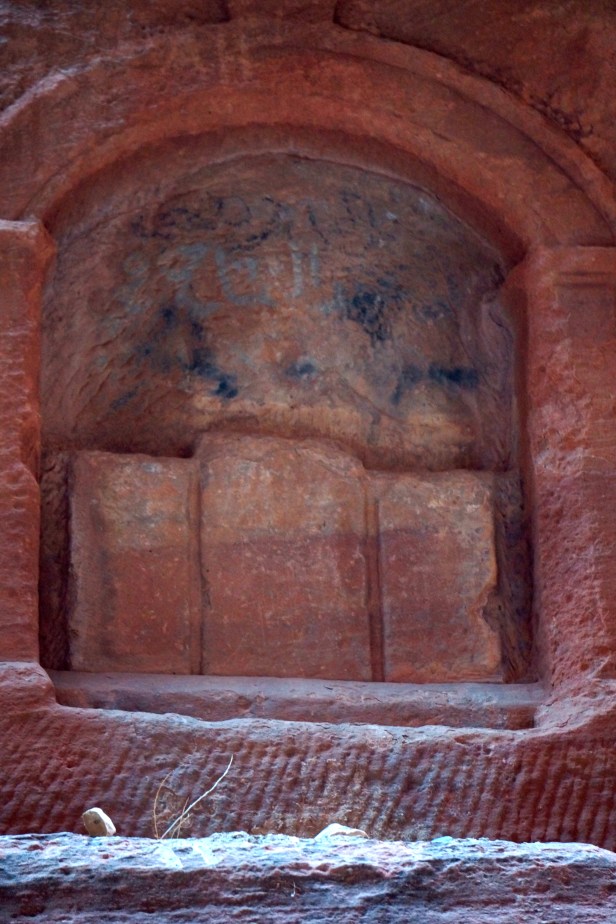


The Treasury (Al Khazna) is the most magnificent facade in Petra. It’s almost 40 meters (131 feet) high and intricately decorated with Corinthian Columns, and more. The Treasury is crowned by a funerary urn, which according to local legend conceals a pharaoh’s treasure.


In 1990 Kenneth W. Russell discovered the remains of a Byzantine era church on the north slope of the Colonnade Street. The church contained mosaic floors, marble screens, side rooms, a baptismal tank, and a room full of burnt scrolls, now known as the Petra Scrolls. The quality of the floor mosaics, which pave both side aisles and are well preserved, attest to the church’s significance.


The City of Petra flourished for over 400 years around the time of the Romans and contains over 800 individual monuments including funerary halls, temples, arched gateways and colonnaded streets. The Nabataeans thrived in Petra for about a thousand years, and their metropolis peaked in the centuries just before and after AD 1 when caravan routes from Syria, Arabia, and Egypt found their way to Petra’s gates. There is little information about the Nabataeans and these Arab people excelled at trading. It was by their commercial acumen that they became a wealthy and an extremely formidable regional power. They controlled what is now Israel and Jordan into the northern Arabian Peninsula and later they became part of the Roman Empire. At one point there were 30,000 people living in ancient Petra. Interestingly according to our guide, people still lived in Petra up to 1985.
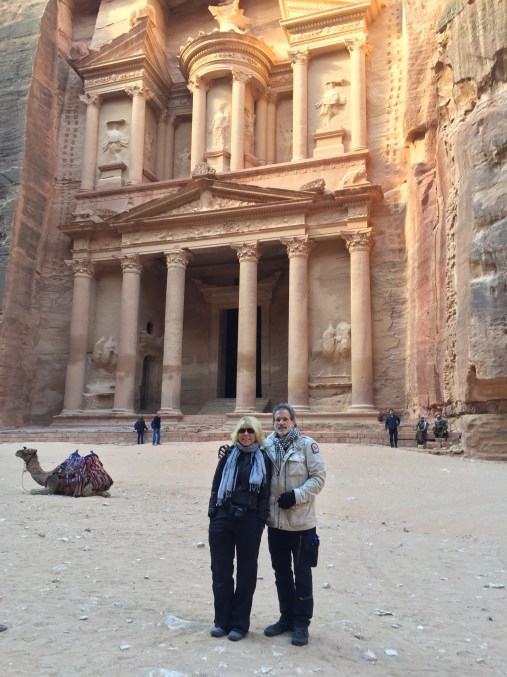


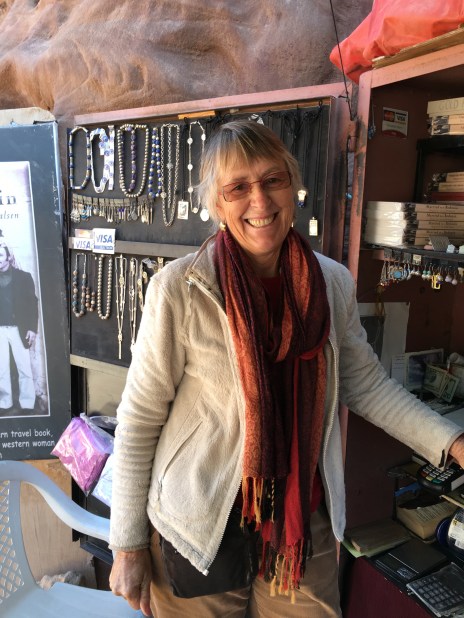
We met a woman, Marguerite van Geldermalsen, who married a Bedouin. She met him on the steps of the Treasury and married him two months later in 1978. She was on a trip from New Zealand and seeking adventure and she sure got what she wanted in spades! Her husband died in 2002 and she continues to live in Jordan near Petra with visits to New Zealand and Australia. She was super interesting! She wrote a book, Married to a Bedouin, which I bought of course!
When we walked out of Petra we saw a horse and buggy going full blast! Pretty exciting. And, did I mention, that part of the road used by the Romans still exists? It does!

The following day we visited Wadi Rum while on our way to the airport.
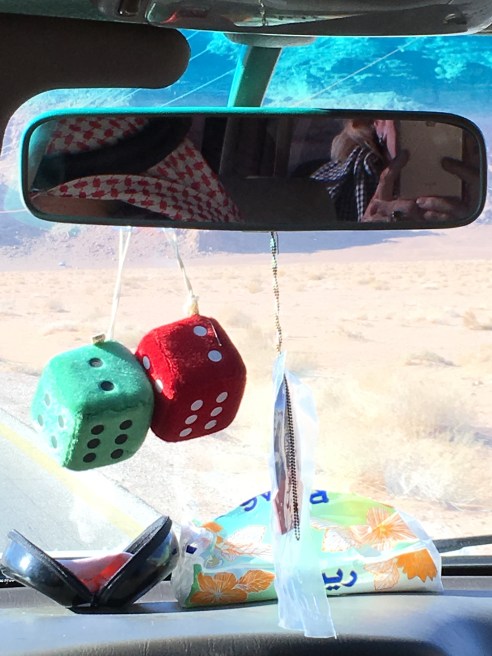
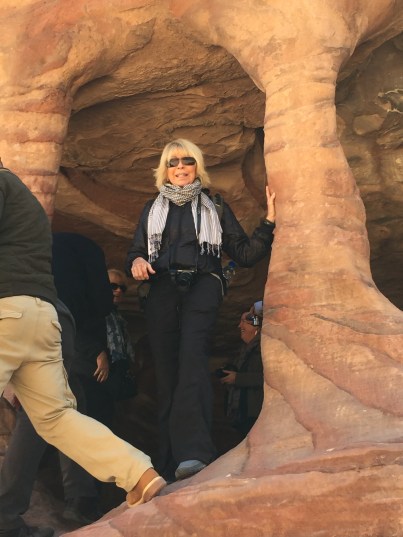
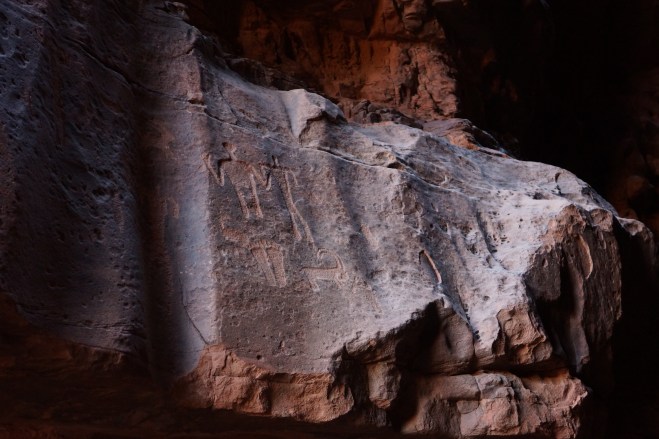
Wadi Rum is a protected area covering about 280 square miles of dramatic desert wilderness in the south of Jordan. Huge mountains of sandstone and granite emerge, sheer-sided, from wide sandy valleys to reach heights of 1700 meters and more. Narrow canyons and fissures cut deep into the mountains and many conceal ancient rock drawings etched by the peoples of the desert over millennia. Bedouin tribes still live among the mountains of Wadi Rum, although I’m not sure if they are nomadic. All the tents we saw seemed to have permanent foundations!
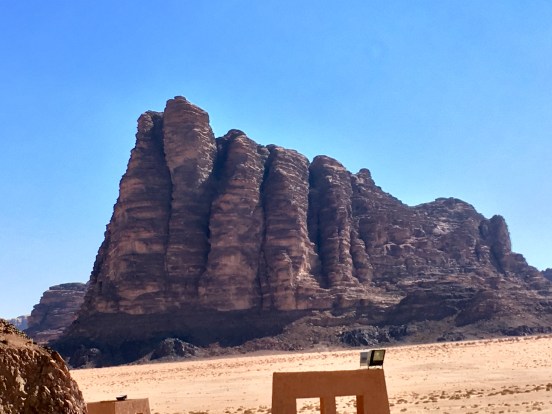
Local people gained notoriety when they joined the Arab revolt forces under the leadership of King Faisal and fought along with Lawrence of Arabia during the Arab Revolt (1917/18) to fight the occupying Turkish and German armies. Lawrence himself makes many references to Wadi Rum in his book ‘The Seven Pillars of Wisdom’, a title apparently inspired by one of Rum’s imposing mountains that was visible upon entry to the Wadi.


Virtually all the people living in and around Wadi Rum today are of Bedouin origin and, until recently, led nomadic lives, relying on their goatherds. We went to a hospitality tent (seriously) that had a foundation! We had tea around a fire…quite hospitable I’d say.
We will be fling to Marrakech and the fabulous Hotel, La Mamounia which got rave reviews from Nancie! Can’t wait to see it and the Majorelle Gardens and the Souks!
 elizabeth rice grossman