Around the World #3

Bucket List!  Rapa Nui or Easter Island with the Moai.

January 26

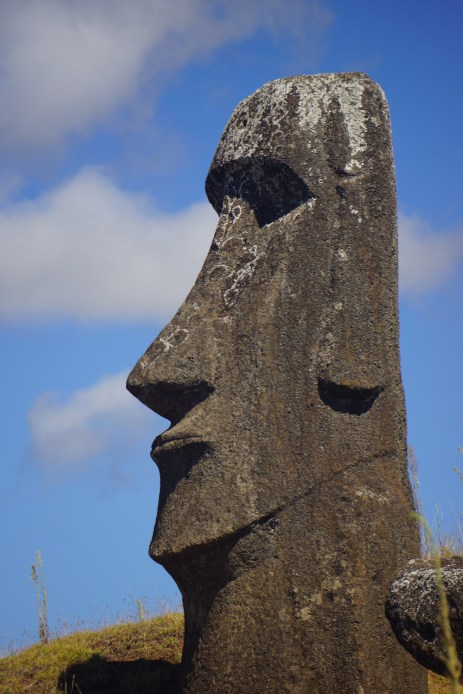
During the day we went to see the Moai …initially at Ahu Tahai, where we saw the original Man Bun

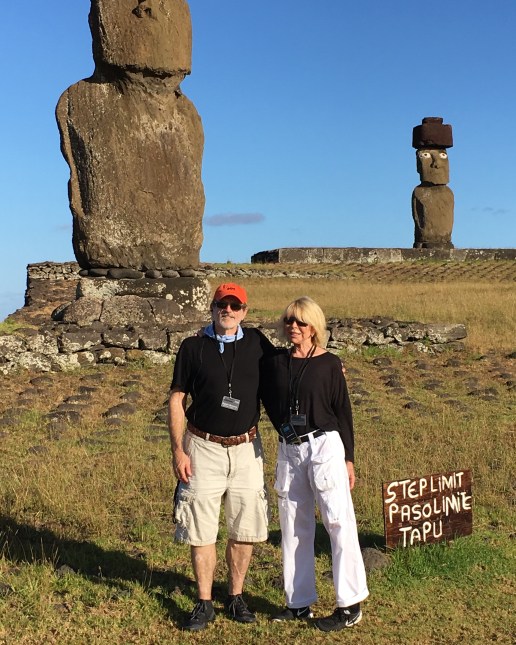
Man Bun
Original Man Bun

Elizabeth and Ralph


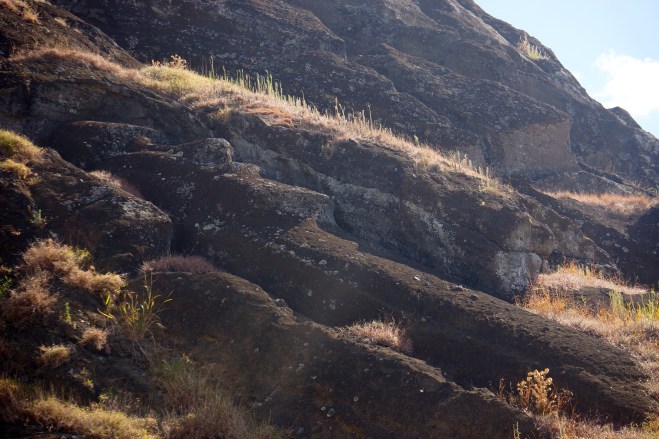
It was believed that the ancestral gods provided personal protection of lineage, territory and property during life as well as in the afterlife. The gods were thought to have brought the migrating birds to Rapa Nui, as well as the migrating fish. There are 887 Moai on Island, and the effort required to move them around the island is almost unimaginable. And, BTW, no one knows for sure why they built them; although most scholars suspect that they are representatives of deified ancestors. Next we were off to the Quarry, Rano Raraku, where we saw the amazing Moai in all their glory. How they moved these statues to the coast is a mystery, especially as they got larger as time progressed. There was an incomplete one that was estimated to be 70 feet long and weighing over 250 tons (photo is lower left).  It was still near where is was carved. It was almost as if the workers just left one day.


Moai Quarry3
Moai Quarry
70 Foot Moai Quarry
70 Foot Moai

After Rano Raraku, we went to see one of the most famous groupings, Ahu Togariki. In a word, WOW!!! They had been largely destroyed in the 60’s during a cyclone and totally restored. One of our guides was the lead archaeologist for that project.  How cool is that?!!  He is currently making a documentary on the restoration which he previewed for us later that evening.  The Japanese government donated a crane, which made it all possible. Pretty great!

Then to lunch at Anakena Beach…good except the flies were as big as humming birds (very slight exaggeration).
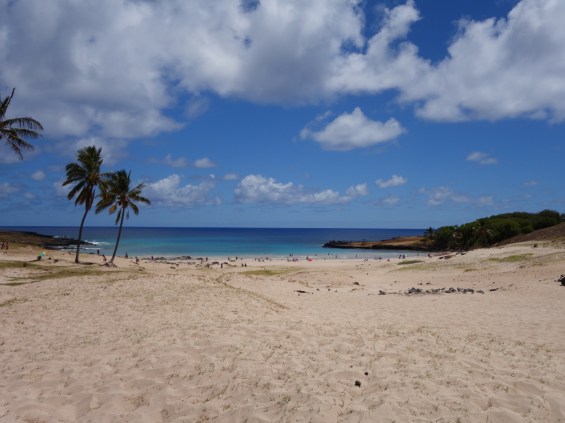
anakena


January 27

We started out at Ahu Togariki to shoot sunrise with Jay Dickman, Pulitzer Prize winning photographer.   Can you imagine? I remember his iconic shot of the Killing Fields in El Salvador.     My photos were not as I had wished and there were tons of people there doing the same thing…made for a difficult shoot.

Sunrise Ahu Tongariki


We had a rainbow over the Quarry (Rano Raraku) and there were wild horses wondering about. There are 3000 horses on Island, and 6000 people. You can’t own property unless you have Polynesian blood.
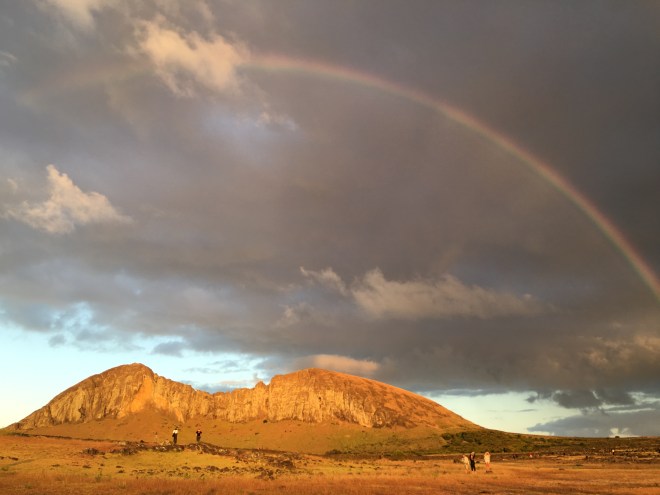
Rainbow
Rainbow


In the evening, we had Polynesian dancers from Rapa Nui. While the musicians and singers wore Hakus they didn’t really seem Hawaiian in dance, rather more like New Zealand. Very aggressive and hugely aerobic! Lots of feathers flying! One of the dancers was largely naked, save a bamboo codpiece!   Very fun to watch that guy, as well as watch the other people watching him! Towards the end of the performance, the dancers beckoned people from our group to the stage, and that is precisely why Ralph and I sat in the back.   We had been warned!
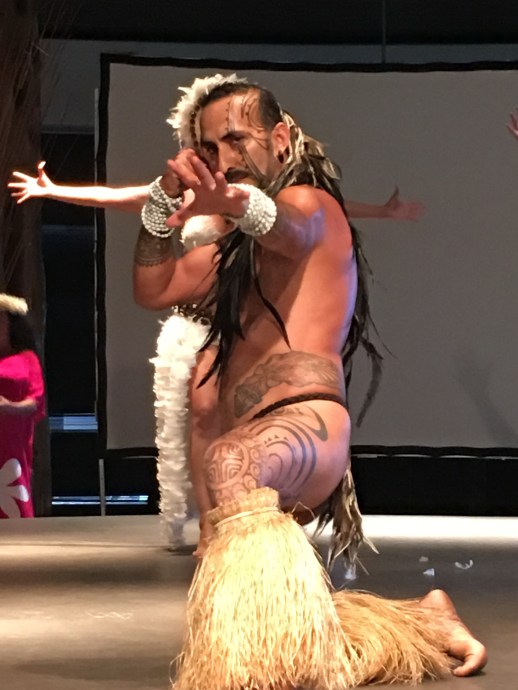
Cod Piece Man
Cod Piece Man


January 28th

Prior to leaving for Samoa, we visited Orongo, most famous for being the ceremonial center of the Birdman Cult (Make-Make Cult). The village was used only a few weeks during the year and only at the beginning of spring. The Make-Make god was closely related to fertility, spring and migratory seabirds. Every year, the chiefs of different tribes competed to obtain the first egg of the Sooty Tern. The participants went down the cliff and swam to Motu Nui, sometimes staying there for days or weeks waiting for the arrival of the seabirds. The first person, or the chief he represented,  who returned to the village with the intact egg,  was named  Tangata-Manu (Birdman). The new Birdman was considered tapu, or sacred and lived in ceremonial seclusion for the following year, when a new Tangata-Manu would be named. The last contest occurred around 1867.


The photo below is from Rapa Nui, and it is reminiscent of the construction at Machu Picchu.  Makes you wonder!
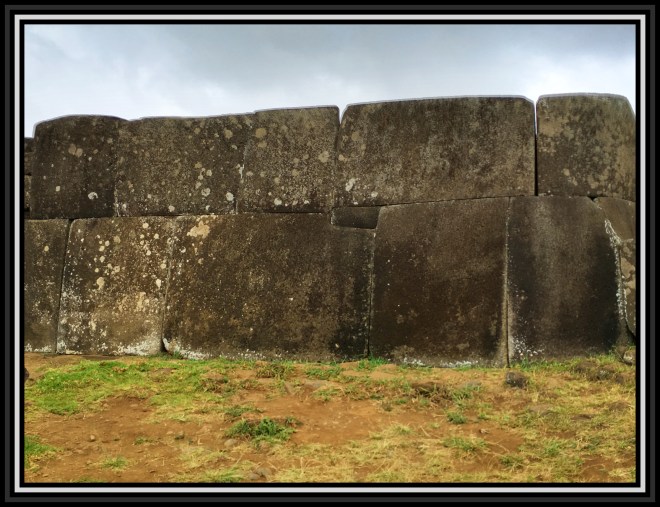
Construction similar to Inca
Polynesians and Incas had similar building styles


Next to Samoa and Australia, followed (too closely!) by Cambodia (another bucket list destination).

Around the World #3

Around the World #2

Cusco and Chinchero and Machu Picchu

Machu Picchu from the top

22 and 23 January 2016

Boy and his Llama


We left Lima after a 6 ½ flight from Orlando…Oy Vey. The food on the plane was amazing (Katy told me it would be). Chef Mike is even taking care of my “special needs”

Of course I cheated on Caviar!

IMG_1400


The Hotel Palacio Nazarenas is fabulous. The rooms are amazing and the bathroom is very nice. The Hotel is centrally located and the food is spectacular! (I guess it’s all about the food.) They are constantly feeding us. Peru is noted for its potatoes, producing over 1,000 varieties. And, they are yummy.

IMG_0745


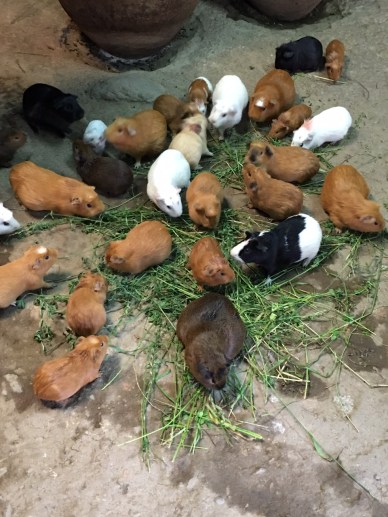
They also eat Guinea Pigs, but I’m not going there.  Well, perhaps just a little bit.  The Guinea Pigs live in the homes, happily eating their meals  on the kitchen floor until…… they meet their fate…Oh dear!

Dinner
Dinner!


Cusco is located about 11,200 feet above sea level. Many people experience altitude sickness…not me this time! Ralph, unfortunately, had a mild case. Cusco was the site of the Inca Empire from the 13th to the 16th Century. The Spanish conquered the Incas in 1532, and according to our guide, proceeded to destroy the Inca shrines to their Gods and many structures. A very sad story, and an all too familiar story currently and throughout history. The indigenous people of Cusco speak Quechuan, which is nothing like Spanish.  They also speak Spanish and, in the tourist industry, of course, English

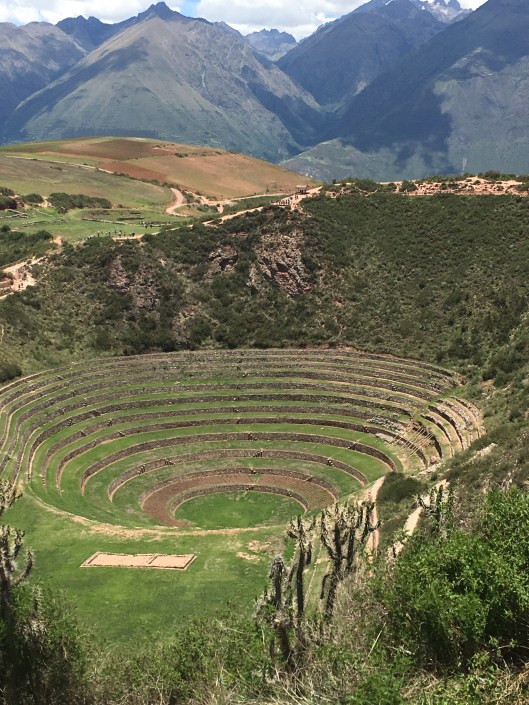
We visited the Chinchero Archaeological site. This village was an Inca Fortress, and mythically believed to be the origin of the rainbow. (Those of us that live in Hawaii know better!)  Our Guide, Ronald was quite proud of his 100% Inca heritage, and rightfully so. The Incas created an amazing method of terrace farming and we were lucky to see a circular one in the ruins of Moray. They are micro climates…very cool.

IMG_0778
Circular Terrace Moray


We topped off our day with a visit to the Cathedral in the Plaza de Armas. We were not allowed to take photos inside (and they charged us admission!) and suffice it to say, it was magnificent. Blinded by the gold leaf!


We visited Machu Picchu the next day.  I realized it’s been 21 years since I was last there!

Machu Picchu is evidence of the urban Inca Empire.  A citadel of cut stone fit together without mortar so tightly that its cracks still can’t be penetrated by a knife blade.  It is believed it was built as a ceremonial site or a military strong hold or a retreat for ruling elites.  Unfortunately the Incas did not have a written language and there is no record on why they built Machu Picchu.  There are 700 plus terraces which preserved soil and promoted agriculture and served as part of an extensive water distribution system.

Machu Picchu was rediscovered in 1911 by Hiram Bingham.  Indigenous peoples knew of the site, and the Spanish invaders never did which helped to preserve the site.  It is so impressive that they built this site over 500 years ago without the benefit of iron, steel and wheels!  Amazing.


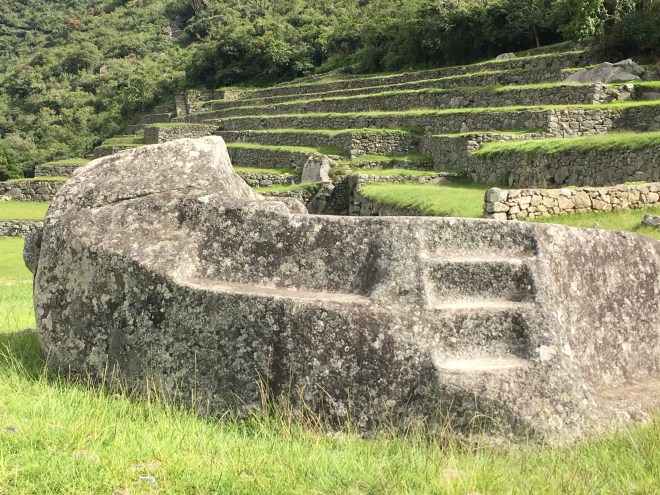
The photo below is of a “Ceremonial Rock” which may have been used for sacrifices (human kind) according to my guide 21 years ago!  Not so now…revisionist history I guess.

Ceremonial Rock
Ceremonial Rock Machu Picchu


After our visit, and prior to boarding the Hiram Bingham Luxury train for our trip back to Cusco, we visited a market place and I bought a pair of pants…$10!  Saw a seriously cute dog as well and had to include him…wanted to bring him home.


Next Stop Rapa Nui (Easter Island) and the Moai!  Bucket List!


Around the World #2

Around the World with Natgeo!

Around the World with National Geographic


21 January 2016


Tomorrow we start our trip with a visit to Peru and Cusco/Machu Picchu. Of course I forgot a few things, and Ralph “needed” a jacket in case we had to dress for dinner in Marrakech. Fortunately, Orlando boasts one the best Malls ever! All the stores we know and love except Hermes!   R got a really nice jacket for $112 (on sale and then 50% off today).

Tonight we meet our fellow travelers over cocktails and dinner.  Feels like the first day of High School in a new city!

Tomorrow we leave at 6:30 am for our flight where we will transfer to what I thought was a charter flight to Cusco……new literature given to us upon arrival in Orlando, however, now refers to this flight as a “local” flight to Cusco!  I’ve been on that flight before….oh dear!

Uber is alive and well in Orlando (thank God) and we used it to return to the Ritz (very nice) from the fabulous Mall at Millenia.  No Uber Black Car, however!  When in Rome, etc.


Around the World with Natgeo!

A Time for Choosing: 2016 and Presidential Leadership

2016

Rare is the moment when America may enjoy both peace and prosperity at home, and tranquility abroad.

For the sins that can consume us as individuals – faults such as greed, vanity, vengeance and the lust for power – are the same vices that can strike nations that seek the fruits of war without the blood of the battlefield.

Many of those countries will wage war – some of those countries are already at war – while others are stateless enemies of civilization: They are terrorists, most of them jihadists and Muslim extremists, for whom human rights, national sovereignty, language, law, literature and tradition, as well as the very rules of war, are a fiction; to be severed by the sword, a beheading from the map not unlike the crude murder of innocents in Syria, Gaza and Iraq, so civil society can vanish while the caliphate rises.

As citizens, and as voters with the chance to elect (in November 2016) the forty-fifth President of the United States, we have a duty to study that map – and the map of Europe and Asia, too – because we can neither isolate ourselves from these threats nor appease those responsible for them.

All these problems are serious; none of them is intractable. But each of these challenges will worsen, if our next commander-in-chief treats these incidents like pockets of regional unrest rather than a network of forces arrayed against our interests and the sustained independence of our allies.

I issue these words as an observer, not as a partisan Democrat or Republican blinded by ideology and poisoned by propaganda. I have no talking points, and I wear no button for or against a candidate.

Instead, I see fascism in Moscow, madness in Damascus, belligerence in Beijing and the resurgence of the Taliban in Afghanistan. And I hear nothing from the powers that be in Washington, DC.

Let us, therefore, look at the price of doing nothing.

Among the Poles, the Czechs and the Slovaks – among the survivors of the most vile forms of tyranny to befall mankind, the evils of Hitler and Stalin, among this trio of nations where the Nazis fed the crematoria with the corpses of children and the Soviets purged whole communities through show trials and mass shootings – these countries only know two decades of freedom . . . and they look to us with hope as they look eastward in fear.

They see our infamous “reset” with Russia, the withdrawal of a missile defense system, leaving these countries just as vulnerable, today, to the territorial ambitions of Vladimir Putin as they were, 70 years prior, to the terms of the Yalta Conference and their enslavement by the Red Army.

In the Middle East, the Israelis see Iran ascendant. They see the obvious: A country with rich reserves of oil and natural gas that, in defiance of common sense and dependent on the West’s willing suspension of disbelief, would rather build nuclear reactors to solve its nonexistent “energy crisis” than admit its plans to harvest plutonium and aim its missiles toward Jerusalem and Tel Aviv.

In Asia, North Korea continues to starve its citizens, and imprison and torture dissidents, while the country expands its cache of nuclear weapons and tightens its ties with China.

Look, finally, at that nation of 1.3 billion people.

Look at her construction of an imperial navy, and her reclamation of the South China Sea by way of the creation of artificial islands; potential military bases and landing strips for fighter jets and bombers, a twenty-first century version of the Japanese Empire’s control of places like the Gilbert and Marshall Islands, and the Solomon Islands and New Guinea.

Across the globe, America is either silent or in retreat.

Our next president must lead.

Our next president can give us peace only if we give ourselves – and our friends – strength.

Now is a time for choosing.

A Time for Choosing: 2016 and Presidential Leadership

An Olympian for the Ages, with the Chance to Make Olympic Strides for Women the World Over: The Power of Caitlyn Jenner

The story of Caitlyn Jenner – the transitioning of Bruce Jenner, former decathlete and erstwhile supporting actor of reality TV, into a woman – is not just an opportunity to sell magazines and increase ratings, with “reportage” that ranges from the sordid and the sensational to the superficial and the snide.

It is a chance for a woman to embrace her authentic self, to take deserved pride in her transition, while not forsaking the moment to make Olympic strides for women the world over.

For, after the media coverage ends, if it ever ends, there will arise a question of conscience, a query of duty and justice: How can Caitlyn Jenner use her fame to celebrate something greater than her physical appearance and her forthcoming promotional deals with various fashion brands and cosmetic companies?

Why should she concern herself more with where women fit in society than how she, Ms. Jenner, fits in some haute couture dress supplied by Vanity Fair?

The question is rhetorical because, in an age where gender inequality persists and the enslavement of women and girls is a global threat, Caitlyn Jenner has an international platform to fight vicious stereotypes and liberate tens of millions of women from abuse, neglect, torture, and sexual harassment.

Remember: Caitlyn is the fulfillment of Bruce, a man of raw strength and the winner of a two-day contest that tests the will – and taxes the body – in ways only the most hardened competitors can imagine and the strictest coaches will demand; training for years, in anonymity, to emerge victorious in the Games of the XXI Olympiad, and immortalized on hundreds of millions of cereal boxes that contain “The Breakfast of Champions.”

Or, there is no man woman enough to challenge Caitlyn’s force and bravery.

It would be a shame, therefore, if Caitlyn were to allow herself to be nothing more than a thing of beauty – a specimen of medical advances and a living mannequin for various shades of lipstick, fillers, nail polish and false eyelashes.

She can earn all the wealth she wants, at the expense of impoverishing her soul, unless she enriches the spirit of humankind with a call to respect, fairness and decency.

Caitlyn can be our voice for something more, something better.

Think of the reaction, and the subsequent debate and conversation, if Caitlyn were to issue just one tweet or Facebook post about the persistence of pay inequity.

Imagine the national or international reception – picture this fearless act of hope – where, despite the sexist responses and the ugly threats, there would be an overwhelming chorus of these three words of social change: “Yes We Can.”

Envision, too, the comfort Caitlyn can inspire – and the lives she can save – by writing and speaking with empathy for those too intimidated to be their genuine selves; too bullied and encircled to free themselves, by themselves alone, of the violent bigotry that pervades their schools and their homes, their communities and their churches.

I have high expectations for Caitlyn Jenner because I know how successful Bruce Jenner was. The latter has a legacy of triumph, on the playing field and in the boardroom, which Caitlyn now possesses.

She has the talent to win, and the resolve to persevere, for whatever she wants.

She has a worldwide sisterhood of every race, color and nationality, ready to march towards progress and personal freedom.

Caitlyn should summon us to victory, period.

caitlyn-jenner-july-2015-vf-01


Elizabeth Rice Grossman

An Olympian for the Ages, with the Chance to Make Olympic Strides for Women the World Over: The Power of Caitlyn Jenner

The Essence of Leadership

Fallible, Yes; Flippant, Never: The Essence of Leadership

As a witness to great leadership, there is one thing every leader I know possesses: An extraordinary degree of calmness during moments of crisis, in the midst, respectively, of a global financial panic and a surgical ward infused with urgency – a race not so much against time, as an attempt, by a commanding personality alone, to pause it – where burn victims, including children, lie on gurneys; their lives suspended in an indescribable state between the present and the brightness of a white light.

Extreme examples of leadership, yes, but practical examples just the same because, if you choose to be a leader – if you are an enterprising woman, you are already a member of this sorority – then you must be a model of calmness. For your actions will do more to inspire respect and loyalty than any words you can issue, no matter how loud you shout or how threatening you pretend to be.

Actions precede words; they are the prose by which we march, filled with the poetry by which we “shall not fail or falter”, the promise by a leader – and the resolve of a people – that we “shall not weaken or tire.”

I write these words on the eve of the seventieth anniversary of Victory in Europe, or V-E, Day, when, isolated and bombed by the terror attacks of the Nazis, with the English Channel patrolled and torpedoed by German U-boats and the French Third Republic ruined and enslaved, Winston Churchill’s words were an arsenal of democracy. His speeches will last a thousand years because his actions – his bravery in the streets, walking through the rubble to shake hands with the miners and bricklayers, and the old matrons and anxious mothers – are unforgettable.

I also write these words as, respectively, the former Managing Director of a genius financier, George Soros, and the spouse of a gifted surgeon, Dr. Richard Grossman.

The former has the calmness born of perspective, where, having seen his native Hungary invaded by Hitler’s army and then occupied by Stalin’s soldiers, and having seen – and been spared – the roundups and mass deportations, only to have then seen the beauty of Budapest befouled by the twin infernos of the Holocaust and Soviet tyranny, this boy would emerge as a man; having seen the worst of mankind, he would lead with the best traits of humankind.

Unflappable in hours of turmoil, with currency markets in a state of chaos and traders reduced from braggarts to banshees of doom and gloom, I would see George as the embodiment of cool. His example never ceases to inspire me because it is a reminder of the humility so many great leaders display.

As for Richard, whose memory I cherish across the veil of years, his leadership survives because of the patients who continue to thrive, thanks to his gentle touch and generous demeanor.

To the nurses and physicians who knew him, among the men and women who remember him, the image is incandescent: Free of titles, laurels and ribbons, and wearing a plain doctor’s coat (his name, sewn in cursive, above his left breast pocket) or green surgical scrubs, his character would enliven any operating room.

I see the calmness in his eyes, a Hawaiian blue like the ocean water at Lanikai Beach. A leader with those eyes speaks without saying, and pacifies a patient and reassures staff with a simple look. Those eyes – and that face, framed in desktop photos and regal portraits – comfort me still.

These two men show this writer, this enterprising woman, how to lead with dignity and act with authority.

With composure and vision, and free of malice and charitable by nature, we can be the leaders we aspire to be.

We can be the leaders we need to be.

We can be the leaders we are.

Elizabeth Rice Grossman

The Essence of Leadership

The Need for a Flat Tax

An Equal Rate for an Equal Citizenry: The Need for a Flat Tax

As a nation with a serious case of income inequality, the best solution to this problem is a 17% flat tax. The form itself would be no larger than a postcard; its questions no more difficult than registering to join Facebook or Twitter.

To anyone who argues against this proposal, to those who believe the enactment of a flat tax is improbable and its use is impractical, I suggest we look at the existing alternative: An ever-growing volume of biblical proportions – an agency bible that exceeds the word count of the actual Bible – that is less intelligible than calculus, more impenetrable than astrophysics and more intimidating than six weeks of boot camp at Parris Island.

I do not exaggerate when I make these comparisons because our tax code is so confusing – so deliberately confusing – that its interpretation involves a squadron of lawyers, accountants, financial planners, former IRS officers and forensic experts.

It is this self-perpetuating series of addenda, appendices, revisions and subsections that is responsible for the permanent employment of tax specialists, the anointed priests of the U.S. Department of the Treasury and top law firms, that is the greatest contributor to income inequality.

If you want to see the results of this imbalance, look no further than the wreckage of downtown Baltimore where, conflicts between African-Americas and the police notwithstanding, poor people do not have the luxury of exploiting the tax code; they do not have the skills to maximize every deduction and claim every relevant exemption.

In this void, where the wealthy escape the highest rates of assessment and the impoverished fail to enjoy the lowest rates of taxation, there is a huge transfer of money out of the city – a cultural exhalation as awful as the inhalation of oxygen fueling the fires of abandoned warehouses and looted stores – that leaves almost nothing for education and infrastructure.

A flat tax is not a panacea for some of these issues, which are as old as the founding of this country and as constant as humanity itself, but it is not without its power to make America a fairer society because economic justice is the basis of social justice.

The best example of this point is well beyond our shores, in Hong Kong, where, without rich deposits of natural resources and no military influence save a few ceremonial positions during British colonial rule, the world’s most vertical city – a region of limited flat land and the dense concentration of skyscrapers – is a financial success, peopled by a literate, industrious and talented citizenry.

With a 15% flat tax, Hong Kong outperforms the United States with a lower unemployment rate, lower individual and corporate tax rates, and an overall lower tax burden as a percentage of GDP, according to Business Insider.

Whether America adopts a 15% or 17% flat tax is less important than the simplification of the tax code in its entirety. The federal government could collect more revenues, and have less people manipulating the system (who manage, by actions unethical or otherwise, to pay no income tax), because filing and mailing a postcard is matter of seconds and cents ($0.34, to be exact).

A flat tax is an antidote to the cynicism that pollutes our politics, and corrupts our sense of civic duty. It is a leveler for inclusion – an ingathering of our fellow Americans – so we get the government we deserve, which is also all the government we need.

Fair and transparent, and proven and popular, a flat tax is an overdue necessity.

The urgency is undeniable, and the demand is unmistakable.

We need a flat tax now!

Elizabeth Rice Grossman

Featured image

The Need for a Flat Tax

A Thirst for Water and a Hunger for Greed

A Thirst for Water and a Hunger for Greed: Ending Price Gouging at the Nation’s Airports

With California in the midst of an unprecedented drought, there is something more than a bit unjust about paying $6 for a liter of “designer water” at Los Angeles International Airport (LAX). Since this overpriced water comes from springs and wells outside of the Golden State, because so much of the water at airport kiosks originates from pumps and aquifers in locales as varied as Maine or Fiji, we should not have to indulge the greed of companies with a monopoly on the sale of something that is otherwise free.

This issue is a matter of moral justice and economic fairness because, as planes ascend or begin their descent into San Diego or San Francisco, when you fly the length of California and see the brown fields and parched earth of the San Joaquin Valley and the empty reservoirs of desert landscapes, it becomes all the more obscene to think businesses would sooner gouge consumers than try to win their loyalty.

And, security rules and dire predictions to the contrary, it is also somewhat absurd that a person cannot bring a bottle of water – one he or she is visibly drinking – past a certain checkpoint, as if a grandmother or sleep deprived parent is a would-be terrorist.

Instead, we have world-famous coffee companies and their barking baristas, and regional newsstands and their curt cashiers, demanding premium prices for an item that most restaurants offer as a complimentary refreshment.

The inconvenience to consumers is one thing, but the reasoning behind it is something else entirely. Indeed, the rationale is so offensive because it is so obvious: It is an admission-by-pricing that a company knows you have no choice but one, so, rather than uphold the spirit of the marketplace (as opposed to this artificially inflated scenario), we have brands choosing greed over integrity.

Travelers know they are captives of their own environment; they await their flights in seating areas where the smell of fast food and heavily sugared sweet buns fills the air, where nutrition is a foreign word and service is a novel concept.

There is, however, a limit to everything. There comes a time, and that moment is now, when greed is so excessive it causes a backlash. The subsequent outrage and lawsuits are a predictable response to these airport monopolies.

What concerns me is the lack of thought – the absence of even the slightest pangs of guilt – by store managers and executives that milking consumers for a bottle of water is a good idea.

Are these people unaware of the power of social media and negative publicity? Do they think a smile is a substitute for decent service, and not a smirk at our collective expense, as each of us surrenders a twenty-dollar bill for two bottles of water and a soggy sandwich?

When these companies make the majority of their money elsewhere, why must they insist on insulting our intelligence in this enclosed space of nowhere – nowhere to bid or barter; nowhere to browse or buy from more than one merchant?

The drought mentioned earlier is real; the manufactured one, at LAX and beyond, is unconscionable. It is wrong because it is so unnecessary, a rounding error on a global brand’s balance sheet.

And yet, these companies persist with pettiness-through-pricing.

The shame is not in the act itself, though it is most definitely shameful; the shame is in the smallness of the decision by these businesses to even think of doing such a thing.

Awash in profits, these companies should be good corporate citizens.

They could do worse than follow this sacred rule:

“For I was hungry, and you gave Me something to eat; I was thirsty, and you gave Me something to drink; I was a stranger, and you invited Me in.”

Featured image

Elizabeth Rice Grossman

A Thirst for Water and a Hunger for Greed

Reclaiming Philanthropy

I write as someone of means, who seeks to reclaim philanthropy for the masses. I write as a philanthropist, who believes social or political change should not be the exclusive domain of a handful of billionaires.

For every Andrew Carnegie or Bill and Melinda Gates, for every public library or concert hall endowed by a departed steel baron, for the great research university that bears his name and on behalf of each civic auditorium that houses his legacy, I applaud the effort to transform the embers of his Pittsburgh furnaces into lanterns of knowledge and light throughout America.

I celebrate the technology wizard, whose vast fortune finances the delivery of clean water and sanitation for tens of millions of people across Africa and the Americas. I rejoice in the delivery of necessities – food, clothing, medicine and shelter – to save mothers from dying during childbirth, and to rescue children from dying in a conflict not of their choosing.

Still, the power to shape the long arc of the moral universe – to ensure it bends towards justice – belongs to everyone.

We need not obsess ourselves with a minority that is rich in goods, when, in fact, there are countless volunteers who are rich in spirit.

Ask me, therefore, the price to change history, at home and abroad, and I will answer with an amount less than the cost of refueling a luxury SUV: $80.

That figure, compounded by matching contributions from my fellow citizens, is the number responsible for, to borrow the words of Abraham Lincoln, the appeal to “the better angels of our nature,” so we could elect a senator from the Land of Lincoln to the White House; binding up old wounds, in celebration, on the evening of November 4, 2008, in Chicago’s Grant Park; where the President-elect, Barack Hussein Obama, the son of a Kansan and a Kenyan, could say: “Yes We Can.”

I cite this event because of then Senator Obama’s ability to raise half a billion dollars online, equal to an average single donation of $80 or less, in his 21-month campaign for the presidency.

I refer to that digital treasury not out of partisanship but awe. Politics aside, that figure proves a more important point: That we all have it in our power to be philanthropic.

Again, I write from experience where the most valuable symbol of philanthropy is time. It is during those hours when you give of yourself – it is across the veil of years, where my beloved husband forever avails himself, as a world-class surgeon, to save people’s lives – that you transcend everyday trifles, and absorb the grandness (and mystery) of life.

When I serve, for example, on the boards of the Honolulu Museum of Art or the Hawaiian Humane Society or the Hawaii Community Foundation or when a meeting comes to order at the Dr. Richard Grossman Community Foundation, I am in the presence of lives lived in full.

We do these things not for moral or monetary remuneration. We do these things because, blessed by our earnings as professionals, we have a universal yearning to do what we can, whenever and wherever we can.

Such is the legacy of my husband, a man of decency and generosity to each patient who saw the soul within his blue eyes.

That humanity survives – no, it flourishes – among each beneficiary of his call to heal the wounded and comfort the fallen. To one, his hands are those of an artist; to another, his palms are the warmth a grieving parent needs and this writer shall never forget.

Whether we give from our pockets or our hearts, we can – and should – give.

Philanthropy is the act of doing.

Let us summon the will to act, today and forevermore.

Featured image

Elizabeth Rice Grossman

Reclaiming Philanthropy

Senior Citizen is So Last Century

The Wise Men and Women Who Transcend Time, or: Why the Term ‘Senior Citizen’ Is So Last Century

Two requests: May companies end the policy of mandatory retirement, when workers turn 65 or 70? And may we also do away with the term senior citizen, which denotes seniority without wisdom and agedness without vitality?

Indeed, these questions should be rhetorical by nature, not an earnest plea for organizations to embrace common sense and for society to choose intelligence over inexperience.

And yet, the requests are real because the problems we face are as real as reality itself.

So, in a nation in the midst of great upheaval, and in a world ravaged by war, terror, famine and environmental catastrophe, why would we consign some of our brightest people to spend their time shuffling cards and playing shuffleboard? Why would we ask the eyewitnesses to history to close their minds because of the number of candles on a birthday cake?

The idea is even more ridiculous when we consider the events of the Second World War. There, speeding through the brown water of the Thames, with the great smokestacks of factories in the background and approaching the grandeur of London’s most famous icons, Westminster Bridge, Big Ben and Parliament, look – seated is a 65-year-old man, bald save a few wisps of faded ginger-colored hair, a senior citizen on a boat ride with his wife (her hair is white); an elderly couple in a black and white photograph, which, sadly, is unrecognizable to most high school and college students.

The man is Winston Churchill, newly appointed prime minister of Great Britain, who wrote (upon assuming power):

“I felt as if I were walking with Destiny, and that all my past life had been but a preparation for this hour and for this trial.”

Should the citizens of the United Kingdom have rejected their leader?

Should King George VI have withheld his assent, when Parliament dissolved itself of appeasement and Mr. Churchill traveled to Buckingham Palace to present his credentials as the Prime Minister of a wartime cabinet?

Should there have been a loud echo of negation all because of Churchill’s age?

Now, as you can see, these questions are as ridiculous as they sound.

In Churchill, we have, simply and quite rightly, a man.

We have many women – and men – who can enrich the world, provided we show these individuals respect and not treat them as a moral salve for own guilt. Or: These people can cross the street themselves, thank you for very much, and they do not believe their age is good for nothing more than discounted movie tickets and an early bird special.

I write these words because I, too, am a “senior citizen”. But I neither act nor feel “old” because, well, I do not know what that is, at least not yet.

I do not, therefore, need pity from an advertiser who deems my generation “undesirable” or “irrelevant,” when, in fact, it is someone else’s ignorance that is unappealing and whose attitude is pointless.

Give me insight independent of age, so I can heal my portion of the world.

Let us give ourselves the encouragement to improve humankind without regard to race, religion, sex or age.

Let us remind ourselves that a country that obsesses about age, but knows nothing about numbers, is as innumerate as it is illiterate.

Which is to say, had Albert Einstein abandoned his work because of his repatriation to America and the passage of his youth, had he stopped theorizing about the cosmos and left his equations unfinished – all because of the false stigma of age – we would have been unworthy of welcoming him to our shores.

We need great leaders, teachers, judges and sages.

They are ready to serve.

Give them their due, but do not call them senior citizens

.Winston Churchill

Senior Citizen is So Last Century